


Best Gynecologist in Chennai
Signs you should visit a Fertility Specialist
By Dr. V. Bharathi, MBBS MS(OBG) FRM | Chief Infertility Specialist, Bharati Fertility Women's Center, Chennai
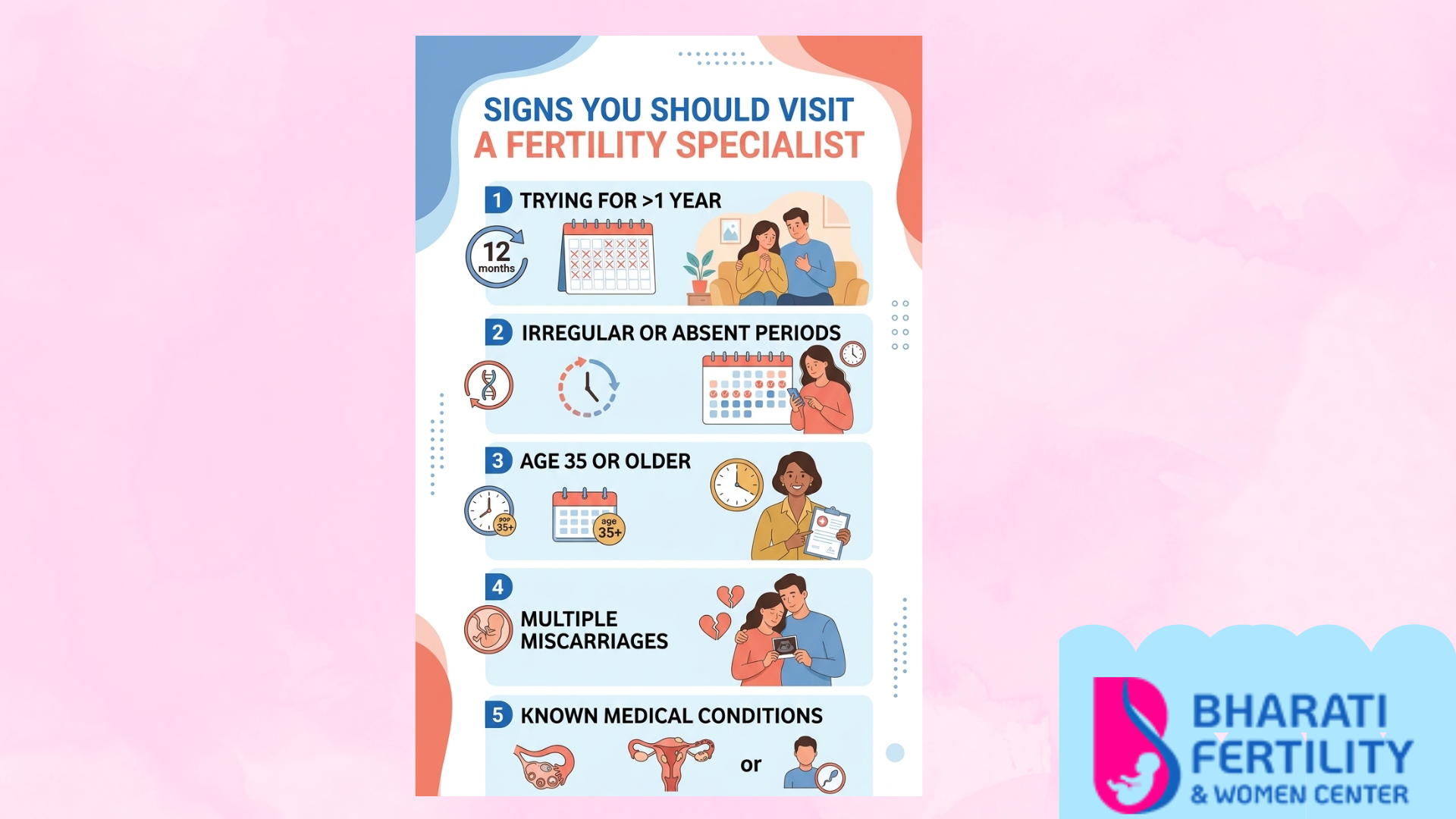
SIGNS YOU SHOULD VISIT A FERTILITY SPECIALIST
One of the most common regrets Dr. V. Bharathi hears from patients at Bharati Fertility Women's Center is: "I wish we had come sooner." Couples who spent months — sometimes years — waiting, hoping, and quietly worrying before finally seeking professional help. And while there is never any judgment in those words, there is an important truth embedded in them: when it comes to fertility, time matters. This blog is for anyone who has been wondering whether it is time to see a specialist. Whether you are just beginning to think about having a baby, have been trying for a while without success, or have noticed something that does not quite feel right — this guide will help you understand the signs that warrant a consultation with a fertility specialist like Dr. V. Bharathi at Bharati Fertility Women's Center.
First, Let's Define "Normal" Before exploring the signs that warrant medical attention, it is worth establishing a baseline. Conception does not always happen immediately, and this is entirely normal. Statistics tell us that: About 85% of couples who try to conceive will achieve pregnancy within 12 months of regular, unprotected intercourse. A further 7% will conceive in the second year of trying. The remaining 8% will require medical assistance. The general medical guideline is that a couple should seek a fertility evaluation after 12 months of regular, unprotected intercourse without conception if the woman is under 35, and after 6 months if she is 35 or older. However-and this is crucial-these timelines are not absolute. There are several circumstances in which you should seek help without waiting, and Dr. V. Bharathi at Bharati Fertility Women's Center strongly encourages you to do so.
Sign #1: Irregular or Absent Periods
A regular menstrual cycle is one of the clearest indicators of healthy ovarian function. A normal cycle falls between 21 and 35 days in length. If your periods are consistently shorter, longer, or unpredictable-or if you go months without a period at all — this is a sign that ovulation may not be occurring normally. The most common causes of irregular periods include PCOS, thyroid disorders, elevated prolactin levels, premature ovarian insufficiency, and hypothalamic dysfunction. All of these are diagnosable and most are treatable. If your cycles are irregular, do not wait 12 months-schedule a consultation at Bharati Fertility Women's Center now.
Sign #2: Very Painful Periods
Menstrual cramps that are severe enough to interfere with daily activities-requiring strong painkillers, causing you to miss work or school, or accompanied by pain during sex or bowel movements-should never be accepted as normal. These symptoms are classic warning signs of endometriosis. Endometriosis is a condition in which tissue similar to the uterine lining grows outside the uterus, causing inflammation, scarring, and damage to the reproductive organs. It is one of the most common causes of infertility and is notoriously underdiagnosed, often taking 7–10 years from symptom onset to diagnosis. Dr. V. Bharathi specialises in the diagnosis and management of endometriosis at Bharati Fertility Women's Center, and early intervention can make a significant difference to your fertility outcomes.
Sign #3: Known or Suspected PCOS
If you have been told you have PCOS-or if you have symptoms such as irregular periods, unexplained weight gain, excess facial or body hair, persistent acne, or skin darkening — you should see a fertility specialist before you begin trying to conceive, not after. PCOS is the most common cause of anovulatory infertility, and knowing about it in advance allows you to proactively manage your hormone levels, optimise your weight, and plan your conception journey with professional support from the outset. At Bharati Fertility Women's Center, Dr. V. Bharathi sees many PCOS patients who achieve pregnancy with targeted, personalised treatment — but timing and early intervention matter.
Sign #4: A History of Pelvic Infections or STIs
Sexually transmitted infections such as chlamydia and gonorrhoea-particularly if they were untreated or diagnosed late-can cause pelvic inflammatory disease (PID), which leaves scar tissue in the fallopian tubes. This scarring can block the tubes partially or completely, preventing eggs and sperm from meeting. If you have a history of pelvic infections, STIs, or PID, it is wise to have a fallopian tube assessment before spending months trying to conceive naturally. At Bharati Fertility Women's Center, tests such as a saline sonography or hysteroscopy can evaluate the uterine cavity and tube patency efficiently and with minimal discomfort.
Sign #5: Previous Abdominal or Pelvic Surgery
Surgeries such as appendectomy, ovarian cyst removal, fibroid surgery (myomectomy), or caesarean sections can sometimes leave adhesions (scar tissue) in the pelvis that affect the fallopian tubes, ovaries, or uterus. If you have had pelvic or abdominal surgery in the past, discussing this with Dr. V. Bharathi at Bharati Fertility Women's Center before you start trying is a sensible precaution.
Sign #6: Two or More Miscarriages
Experiencing a miscarriage is heartbreaking. One miscarriage, though devastating, is unfortunately common-affecting approximately 1 in 4 recognised pregnancies — and is often a chance event with no underlying cause. However, two or more miscarriages-what is clinically defined as recurrent pregnancy loss-is a pattern that warrants investigation. Possible causes include chromosomal abnormalities in the embryo, uterine structural issues (such as a uterine septum or fibroids), hormonal imbalances, thrombophilia (blood clotting disorders), or immunological factors. At Bharati Fertility Women's Center, Dr. V. Bharathi conducts a thorough evaluation for recurrent pregnancy loss, including karyotyping, uterine assessment, hormonal testing, and thrombophilia screening, to identify treatable causes and improve the chances of a successful future pregnancy.
Sign #7: Male Partner Has Known Fertility Issues
Fertility is a two-partner equation. Approximately 40–50% of infertility cases involve a male factor, yet men are often the last to be evaluated. If your partner has a history of undescended testicles, previous groin or scrotal surgery, varicocele, or has never fathered a child despite previous relationships, a semen analysis should be one of the first steps — not an afterthought. At Bharati Fertility Women's Center, semen analysis and advanced male fertility tests including DNA fragmentation, hormonal evaluation, and surgical sperm retrieval procedures (TESA, PESA, Micro-TESA) are available. Dr. V. Bharathi's approach is always to evaluate both partners together from the very first visit.
Sign #8: You Are 35 or Older and Have Just Started Trying
Age is one of the most significant factors in female fertility. A woman's egg count and egg quality decline steadily from her early 30s and more sharply after 35. This does not mean that pregnancy is impossible after 35 — far from it — but it does mean that time is more precious and that earlier evaluation is justified. If you are 35 or older and have just begun trying to conceive, Dr. V. Bharathi recommends seeking a fertility assessment after 6 months rather than waiting a full year. If you are 40 or older, a proactive assessment even before you begin trying is a wise choice. An AMH (Anti-Müllerian Hormone) test and antral follicle count via ultrasound can give a clear picture of your current ovarian reserve and help inform realistic expectations and treatment planning.
Sign #9: You Have Been Trying for 12 Months (or 6 Months if Over 35) Without Success
If you have been having regular, unprotected intercourse-ideally timed around ovulation-for the recommended period of time without achieving pregnancy, it is time to seek a professional evaluation. This is not a sign of failure; it is a sign of being proactive about your health and your future. At Bharati Fertility Women's Center, Dr. V. Bharathi conducts a comprehensive workup for both partners in a structured, non-judgmental environment. In many cases, a cause is identified and a clear treatment plan can be put in place within just a few appointments.
Sign #10: You Simply Have a Gut Feeling Something Is Not Right
Sometimes there is no specific symptom-just an instinct that something is off. Perhaps your periods have changed subtly, you feel unusually fatigued, or you have a sense that your body is not quite in balance. These instincts are worth listening to. At Bharati Fertility Women's Center, Dr. V. Bharathi takes a thorough, whole-person approach to fertility evaluation. You will never be dismissed or told to "just keep trying" without a proper assessment. If you have a concern, it is a valid concern — and it deserves a professional opinion.
What to Expect at Your First Consultation
Many people avoid visiting a fertility specialist because they are not sure what to expect, or because they fear receiving bad news. At Bharati Fertility Women's Center, the first consultation with Dr. V. Bharathi is an open, informative conversation-not an intimidating medical exam. You can expect a thorough review of both partners' medical histories, a discussion of your menstrual and reproductive history, guidance on which initial investigations are appropriate, and a clear explanation of what the results may mean and what the next steps might look like. There is no pressure, no rush, and no judgment.
The Most Important Step Is the First One Whether you have been trying for a year or have only just started thinking about starting a family, whether you have a specific concern or simply want to know more about your fertility-the most important thing is to take that first step. At Bharati Fertility Women's Center, Dr. V. Bharathi and the team are here to give you the information, the support, and the care you need to move forward with confidence. Because every couple deserves answers, and every family deserves its best possible chance.
For compassionate, comprehensive IVF care in Chennai, contact Bharati Fertility Women's Center at +91 82 2005 2005 or Click here to book appointment
Locations: Mandaveli | Urapakkam | Ambattur| Avadi