


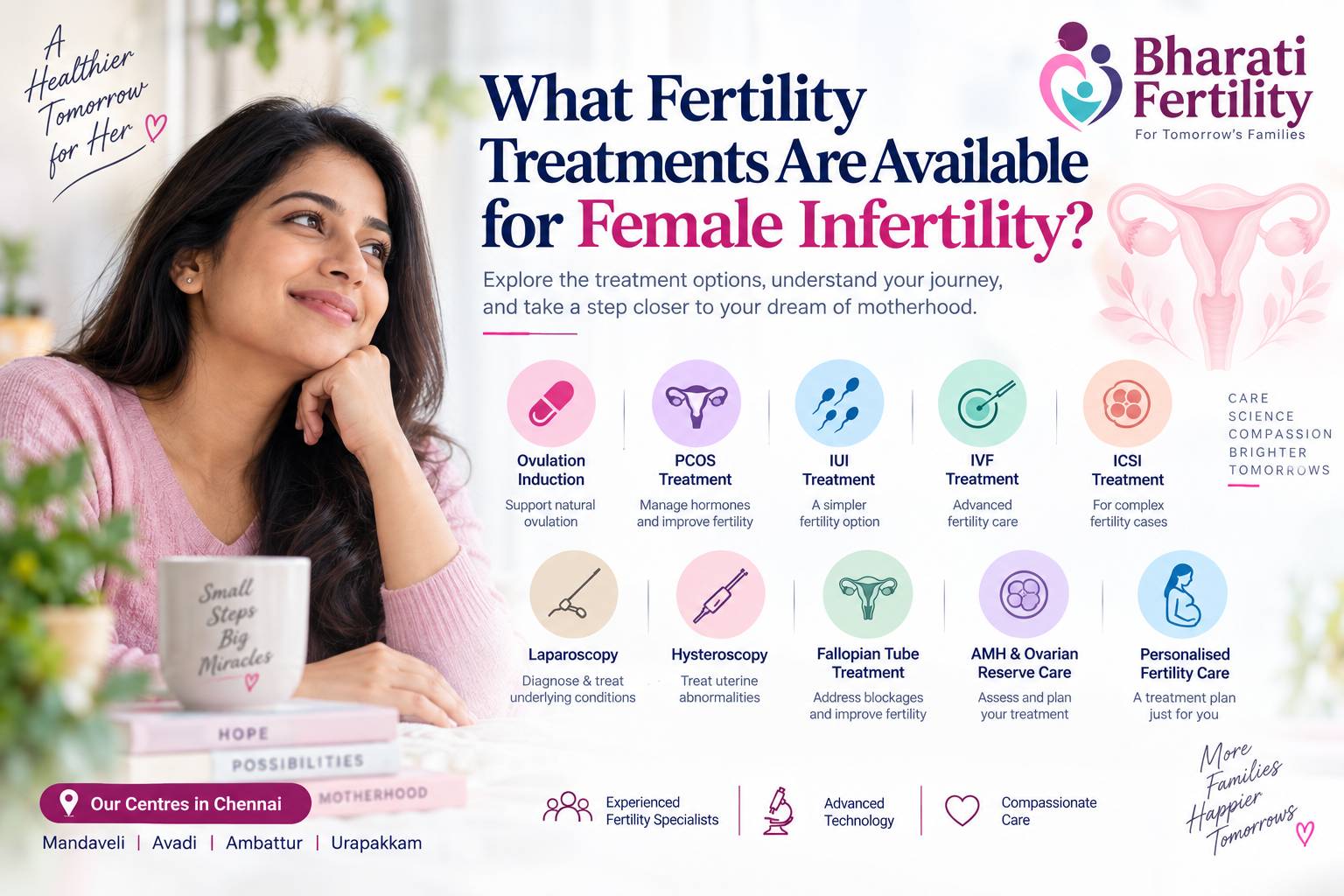
Female infertility can have several possible causes, including problems with ovulation, age-related changes in fertility, blocked fallopian tubes, endometriosis, PCOS, reduced ovarian reserve and conditions affecting the uterus. In some couples, no specific cause is identified even after a standard fertility evaluation.
The good news is that several fertility treatments are available for female infertility, and the appropriate option depends on the underlying cause, age, ovarian reserve, reproductive history and the fertility status of the partner.
For women looking for female infertility treatment in Chennai, understanding the available options can make the fertility journey easier to navigate. Treatments may range from medication and ovulation induction to IUI, IVF, ICSI and selected surgical procedures.
This guide explains the major fertility treatments available for women and when each approach may be considered.
What Is Female Infertility?
Female infertility refers to difficulty becoming pregnant because of factors affecting the female reproductive system.
Some common factors associated with female infertility include:
- Ovulation disorders
- Polycystic ovary syndrome (PCOS)
- Reduced ovarian reserve
- Age-related fertility decline
- Endometriosis
- Blocked or damaged fallopian tubes
- Fibroids or polyps
- Certain uterine abnormalities
- Hormonal disorders
- Previous pelvic infections or surgery
- Recurrent pregnancy loss
- Unexplained infertility
Infertility can involve female factors, male factors or a combination of both. Therefore, fertility evaluation generally considers both partners rather than assuming the cause is related to the woman alone.
How Is Female Infertility Diagnosed?
Before recommending treatment, a fertility specialist usually evaluates the woman's medical history, menstrual cycle, reproductive history and previous pregnancy history.
Depending on the individual situation, investigations may include the following.
1. Ovulation Assessment
Regular ovulation is important for natural conception.
Women with irregular or absent periods may have an ovulation disorder. Conditions such as PCOS can affect ovulation and make conception more difficult.
The doctor may use menstrual history, ultrasound and selected hormone tests to assess ovulation.
2. AMH and Ovarian Reserve Assessment
Anti-Müllerian hormone (AMH) is one of the tests that may be used as part of an ovarian reserve assessment.
It can provide information about the remaining pool of ovarian follicles and may help doctors plan fertility treatment.
However, AMH should not be interpreted on its own as a direct prediction of whether a woman can become pregnant naturally.
Bharati Fertility currently lists AMH treatment/evaluation among its fertility services.
Related keyword: AMH Treatment in Chennai
3. Ultrasound and Antral Follicle Count
An ultrasound examination can help doctors assess the ovaries and uterus.
An antral follicle count (AFC) may also be used as part of ovarian reserve assessment and treatment planning.
Ultrasound can additionally help identify certain conditions such as ovarian cysts, fibroids or other structural abnormalities.
4. Fallopian Tube Evaluation
The fallopian tubes play an important role in natural conception because they provide the pathway for sperm and egg to meet.
Depending on the medical history, a doctor may recommend testing to determine whether the tubes are open.
Tests can include procedures such as HSG or other appropriate investigations.
5. Uterine Evaluation
The uterus needs to provide a suitable environment for embryo implantation and pregnancy.
When clinically indicated, doctors may evaluate the uterus using ultrasound, saline sonography or hysteroscopy.
Bharati Fertility provides hysteroscopy and laparoscopy services as part of its fertility and gynecological care.
What Fertility Treatments Are Available for Female Infertility?
Treatment depends on the cause of infertility.
Some women may conceive with medication or treatment of an underlying condition, while others may require assisted reproductive techniques such as IUI or IVF.
1. Ovulation Induction
Ovulation induction involves using medication to help women who do not ovulate regularly release an egg.
It may be considered for women with certain ovulatory disorders.
For women with PCOS and infertility due to anovulation, the international PCOS guideline identifies letrozole as the first-line pharmacological treatment for ovulation induction when there are no other infertility factors.
Treatment should always be prescribed and monitored by a qualified fertility specialist because the medication, dose and monitoring schedule depend on the individual patient.
2. Fertility Treatment for PCOS
Polycystic ovary syndrome (PCOS) is a common hormonal condition that can affect menstrual cycles and ovulation.
Not every woman with PCOS experiences infertility. However, irregular or absent ovulation can make conception more difficult for some women.
PCOS-related fertility management may involve:
- Lifestyle and metabolic management
- Ovulation induction
- Follicular monitoring
- Timed intercourse
- IUI when appropriate
- IVF when clinically indicated
Bharati Fertility provides PCOS and infertility management and describes personalised treatment approaches for women with PCOS.
Related keyword: PCOS Treatment in Chennai
3. IUI Treatment
Intrauterine insemination (IUI) is a fertility treatment in which prepared sperm are placed directly inside the uterus around the time of ovulation.
IUI may be considered for selected women and couples with:
- Ovulation-related infertility
- Unexplained infertility
- Mild male-factor infertility
- Certain situations involving donor sperm
Bharati Fertility's IUI service information describes IUI as an option for women experiencing ovulation problems and couples with unexplained infertility, among other selected situations.
For unexplained infertility, ASRM guidance supports a course of ovarian stimulation with oral medication and IUI for many couples before moving to IVF, although treatment should be individualised according to age and clinical circumstances.
Related keyword: IUI Treatment in Chennai
4. IVF Treatment
In vitro fertilization (IVF) is one of the most widely used assisted reproductive treatments.
During IVF:
1. The ovaries are stimulated to develop multiple follicles.
2. The developing follicles are monitored.
3. Mature eggs are retrieved.
4. The eggs are fertilized with sperm in the laboratory.
5. The resulting embryos are cultured.
6. An embryo may be transferred into the uterus.
IVF may be considered for several causes of infertility, including:
- Blocked or damaged fallopian tubes
- Endometriosis
- Certain ovulation disorders
- Reduced ovarian reserve
- Some male-factor infertility cases
- Unexplained infertility
- Previous unsuccessful fertility treatments
Bharati Fertility's IVF information describes ovarian stimulation, egg retrieval, laboratory fertilization, embryo development and embryo transfer as key stages of IVF treatment.
Related keyword: IVF Treatment in Chennai
5. ICSI Treatment
Intracytoplasmic sperm injection (ICSI) is a specialised fertilisation technique used as part of an IVF cycle.
In ICSI, a single sperm is injected directly into a mature egg in the laboratory.
ICSI is particularly relevant in selected cases of male-factor infertility, previous fertilisation failure or when surgically retrieved sperm are being used.
Although ICSI is primarily a fertilisation technique rather than a treatment specifically for female infertility, it may form part of an IVF treatment plan when male-factor or previous fertilisation issues are also present.
Bharati Fertility provides IVF/ICSI treatment in Chennai.
Related keyword: ICSI Treatment in Chennai
6. Laparoscopy for Selected Fertility Conditions
Laparoscopy is a minimally invasive surgical procedure that allows a doctor to examine structures inside the pelvis.
Depending on the clinical situation, laparoscopy may help diagnose or treat certain conditions associated with infertility, including:
- Endometriosis
- Pelvic adhesions
- Certain tubal conditions
- Other pelvic abnormalities
Surgery is not automatically required for every woman with infertility. The decision depends on the diagnosis, symptoms, previous treatment and reproductive goals.
Bharati Fertility lists laparoscopy among its fertility and gynecological services.
Related keyword: Laparoscopy for Fertility Treatment
7. Hysteroscopy for Uterine Conditions
Hysteroscopy allows a doctor to examine the inside of the uterus using a thin, lighted instrument.
It can be used to investigate certain abnormalities affecting the uterine cavity and, when appropriate, treat selected conditions.
A hysteroscopy may be considered when a doctor suspects an abnormality such as a polyp, fibroid or other issue affecting the uterine cavity.
Bharati Fertility provides hysteroscopy services and describes both diagnostic and operative hysteroscopy.
Related keyword: Hysteroscopy Treatment in Chennai
8. Treatment for Endometriosis-Related Infertility
Endometriosis occurs when tissue similar to the lining of the uterus grows outside the uterus.
It can be associated with pelvic pain and difficulty conceiving in some women.
Treatment depends on the woman's symptoms, age, fertility goals and severity of the condition.
Depending on the individual situation, management may involve medical treatment, surgery or assisted reproductive treatment such as IUI or IVF.
A fertility specialist can determine which approach is appropriate after evaluation.
9. Treatment for Blocked Fallopian Tubes
Blocked or damaged fallopian tubes can interfere with the meeting of the egg and sperm.
The appropriate treatment depends on:
- Location of the blockage
- Extent of tubal damage
- Age
- Ovarian reserve
- Previous fertility history
- Other infertility factors
In some selected cases, surgical treatment may be considered. For significant tubal disease, IVF may be recommended because IVF bypasses the fallopian tubes.
Bharati Fertility's IVF information identifies tubal disease among the causes for which IVF may be used.
10. Embryo Transfer
Embryo transfer is a key stage of IVF treatment.
After embryos are created in the laboratory, an appropriate embryo may be transferred into the uterus.
The timing and number of embryos transferred depend on the patient's treatment plan, embryo development, age and clinical circumstances.
Bharati Fertility lists embryo transfer as one of its fertility services.
Related keyword: Embryo Transfer Treatment
11. Treatment for Recurrent Implantation Failure
Some patients may experience repeated IVF or embryo-transfer failures.
When implantation repeatedly does not occur, the fertility team may review the previous treatment cycles and investigate possible contributing factors.
The evaluation may consider:
- Uterine factors
- Embryo-related factors
- Hormonal or metabolic factors
- Endometrial factors
- Other medical or reproductive factors
Treatment should be based on the findings rather than automatically adding multiple procedures.
Bharati Fertility currently lists recurrent implantation failure treatment among its services.
How Do Doctors Decide Which Fertility Treatment Is Right?
There is no single fertility treatment that is suitable for every woman.
A fertility specialist may consider:
Age
Female age is an important factor because fertility generally changes with age.
Ovarian Reserve
AMH, AFC and other clinical information can help assess ovarian reserve and guide treatment planning.
Ovulation
Women who do not ovulate regularly may benefit from ovulation-focused treatment.
Fallopian Tubes
The condition and openness of the fallopian tubes can influence whether natural conception, IUI or IVF is appropriate.
Uterine Health
Fibroids, polyps and other uterine abnormalities may affect fertility or implantation and may require further evaluation.
Endometriosis
The severity of endometriosis and its effect on fertility can influence the treatment approach.
Male Fertility
Both partners should be evaluated because male-factor infertility can contribute to difficulty conceiving.
Previous Fertility Treatment
Previous IUI or IVF outcomes may influence the next treatment plan.
Is IVF Always Necessary for Female Infertility?
No.
IVF is an important fertility treatment, but it is not automatically required for every woman.
For example, a woman with an ovulation disorder may first be treated with ovulation induction. A couple with unexplained infertility may be considered for ovarian stimulation with IUI before IVF depending on age and other factors. ASRM guidance supports ovarian stimulation with oral medication plus IUI as an initial treatment approach for many couples with unexplained infertility, followed by IVF when appropriate.
However, women with significant tubal disease, certain fertility conditions or specific treatment histories may be advised to consider IVF earlier.
The best approach is determined after a complete fertility evaluation.
When Should a Woman See a Fertility Specialist?
A fertility evaluation may be appropriate when pregnancy has not occurred after:
- 12 months of regular unprotected intercourse when the woman is under 35.
- 6 months when the woman is 35 or older.
Earlier evaluation may be appropriate when there are known fertility concerns such as:
- Irregular or absent periods
- PCOS
- Endometriosis
- Previous pelvic surgery
- Known tubal problems
- Previous miscarriages
- Reduced ovarian reserve
- Previous unsuccessful fertility treatment
- Other reproductive health concerns
A doctor can determine whether testing or treatment is appropriate based on the individual's circumstances.
Female Infertility Treatment at Bharati Fertility in Chennai
Bharati Fertility provides fertility and women's reproductive healthcare in Chennai.
Its current website lists services including:
- IVF
- ICSI
- IUI
- PCOS treatment
- AMH-related fertility evaluation
- Embryo transfer
- Laparoscopy
- Hysteroscopy
- Recurrent implantation failure treatment
- Male fertility treatment
The centre currently lists locations in Mandaveli, Urapakkam, Ambattur and Avadi.
Bharati Fertility's website identifies Dr. V. Bharathi as an obstetrician and gynecologist specialising in reproductive medicine and laparoscopic surgery. The clinic's About page states that she completed postgraduate training in Obstetrics and Gynecology and further training in reproductive medicine.
Women considering fertility treatment can discuss their reproductive history, investigations and treatment options with a fertility specialist before deciding on the next step.
Frequently Asked Questions About Female Infertility Treatment
What is the most common treatment for female infertility?
There is no single treatment that is best for every woman. Depending on the cause, treatment may include ovulation induction, IUI, surgery or IVF.
Can PCOS cause infertility?
PCOS can affect ovulation and menstrual cycles. Some women with PCOS may therefore experience difficulty conceiving. Ovulation induction and other fertility treatments can be considered depending on the individual's condition.
Can blocked fallopian tubes be treated?
Treatment depends on the location and severity of the blockage. Selected women may be considered for surgery, while IVF may be recommended in cases where the tubes are significantly damaged or blocked.
Is IUI suitable for women with infertility?
IUI can be suitable for selected women and couples, including some cases of ovulation-related or unexplained infertility. The doctor considers factors such as ovulation, tubal status, sperm parameters and age before recommending IUI.
When is IVF recommended for female infertility?
IVF may be considered for several situations, including significant tubal disease, some cases of endometriosis, certain ovulation problems, reduced ovarian reserve, unexplained infertility and previous unsuccessful fertility treatment.
What is the role of AMH in fertility treatment?
AMH can provide information about ovarian reserve and may help doctors plan fertility treatment. However, AMH is only one part of a woman's fertility assessment and should not be used alone to determine the ability to conceive naturally.
Can endometriosis affect fertility?
Yes. Endometriosis can be associated with difficulty conceiving in some women. The appropriate treatment depends on the severity of the condition, symptoms, age and fertility goals.
Where can I get female infertility treatment in Chennai?
Bharati Fertility currently provides fertility and women's reproductive healthcare services at centres in Mandaveli, Urapakkam, Ambattur and Avadi.
Take the Next Step in Your Fertility Journey
Female infertility can have different causes, and the right treatment depends on the individual diagnosis.
From ovulation induction and PCOS management to IUI, IVF, ICSI, laparoscopy and hysteroscopy, several treatment options are available depending on the patient's medical condition.
If you are looking for female infertility treatment in Chennai, a fertility consultation can help identify possible causes and determine which treatment options may be appropriate for you.
Bharati Fertility provides fertility care across Chennai, including Mandaveli, Urapakkam, Ambattur and Avadi.
Book a Fertility Consultation with Bharati Fertility
Medical Disclaimer
This article is intended for general educational purposes only and should not replace medical diagnosis or treatment. Fertility treatment should be planned with a qualified fertility specialist after appropriate evaluation.